


Robert Fisher
Staff Reporter
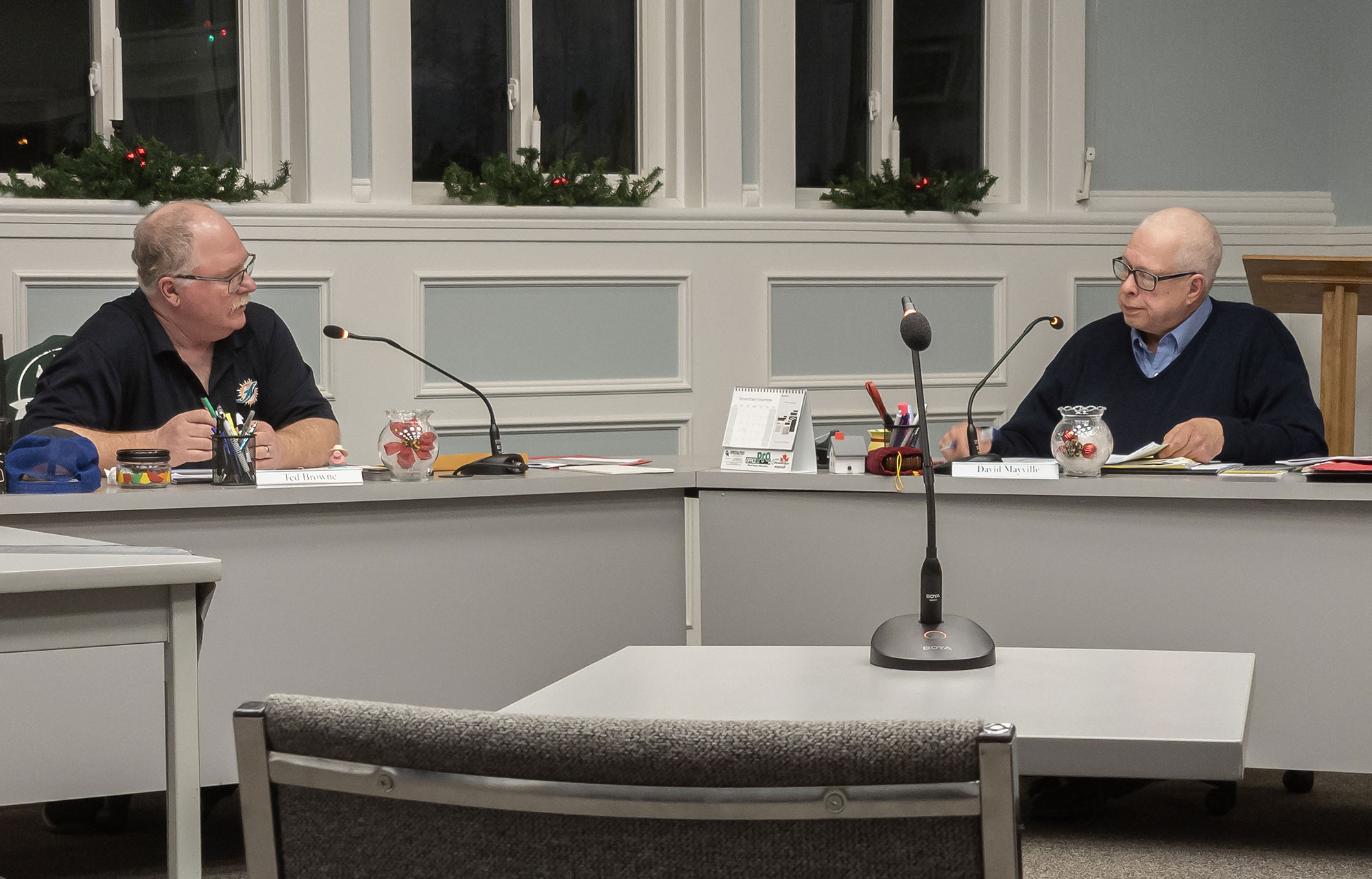
KILLALOE – The Dec. 9 Committee of the Whole meeting for the Township of Killaloe, Hagarty and Richards came to an abrupt end when members, in an apparently pre-orchestrated effort, passed a motion to adjourn the meeting in order to prevent Mayor David Mayville from seeking public input on reducing the size of council and eliminating the ward system.
Several staff reports went unpresented and an in-camera session did not take place. Chief Administrative Officer Tammy Gorgerat did not respond to a question about when the staff reports or in-camera session would be rescheduled for.
Scott Gardner, president of the Round Lake Property Owners Association (RLPOA) delegated at the meeting to seek a status update on the boat launch at Round Lake and to present information he gathered from association members on council composition and the ward system.
The Gazette was copied on an email to all members of council and Gorgerat on Monday evening noting that he had applied to delegate and received no reply. The email included results of the survey. The Gazette sent a message to Gorgerat asking why his delegation request was not granted. We received no reply, however, he did delegate at the meeting. The public meeting agenda available on the mobile version of the township website did not list any delegation. Section 18.2(a) of the council procedural bylaw states, “A final agenda shall be circulated to council members and made public.” The mobile website still did not have the final agenda as of 8 a.m. Friday morning. The final version was only completed at 6:05 p.m. on Dec. 9 according to the file metadata and would only have been posted after that, less than an hour before the scheduled meeting start time.
The delegation
Gardner asked about a status update on the boat launch. Public works superintendent Dean Holly provided information about how the township would approach the project and said the work will have to be done when the water level is low to meet Ministry of Natural Resources requirements. He also asked for an update on signage informing people about not importing invasive species.
Gardner moved into his presentation of the survey results from his members. The survey included two questions. “Do you feel that the council should stay at six or should it go to four?” and “Do you believe that we should stay with the ward system or should we abolish?” it.
Association members could respond to the survey for a two-week period. The association has 304 members. More than 200 responded to the questions, representing over two-thirds of the membership; which is higher than the 60 per cent voter turnout in the 2022 election. Seventy-five per cent of responses favoured reducing council size to four members and 74 per cent favoured eliminating the ward system.
The RLPOA represents approximately 18 per cent of the population of the township, Gardner told council. He based the numbers on the 2021 census which showed a population of 2,410 and 1,097 households and an average of 2.2 people per household. He then multiplied the 204 member households by 2.2 to come up with, roughly, 450 people in favour of reducing council size and eliminating the ward system.
Gardner noted that KHR has a resident to councillor ratio of about 400 to 1. “Other townships are anywhere from 716 to 982 to 1, he said about surrounding municipalities. The number only includes councillors and not the mayor. If the mayor is included, the ratio drops to 344:1 That number changes when all eligible voters are considered. The number of eligible voters in 2022 was 3,184 giving a ratio of 531:1 for six councillors and 454:1 including the mayor. Dropping to four councillors would give a ratio of 796:1 for eligible voters or 637:1 including the mayor (603:1 or 482:1 based on four or five councillors and a population of 2,410.
“You’re elected officials,” Gardner said, “the people entrusted in you to make the decisions within the best interest of the township.” He appreciates that councillors will receive feedback from both sides of the issue. The decision, he said, “should be looked at as a thoughtful reform process based on evidence and best practices. Not other factors that are going on in here and trust me there’s lots. But we need to look at evidence and best practices. That’s the part that I’m trying to say, rather than political or financial or whatever. What is best for the township.”
Gardner stated that a ward system entrenches, what he referred to as, machine politics. He described machine politics as a system where a candidate can craft a message that appeals to a small group of voters, however, does not or may not appeal to the broader populace. At-large voting, conversely, forces candidates to appeal to a broader segment of the community and be responsive to more points of view in order to get elected. Wards and machine politics makes running for election more difficult for new candidates who voters in a ward do not know.
He also presented information about the team size paradox which shows that teams with larger numbers are less efficient and make worse decisions that smaller teams. He provided a graph showing that optimal decision-making happens with teams of four to six people and that a team of five is most effective. The information counters claims from some councillors that a larger team means more input and better decisions as an argument to maintain council at seven members.
“We have the smallest population of the six surrounding townships. What is the justification for the ward system?”
He told council members that with such a small ratio of voters per councillor, it should be easier for them to gauge resident input.
Council response
Coun. Bil Smith, referring to the mayor as “that person” and ongoing “shenanigans” around the issue, replied to Gardner that council doesn’t have the votes, currently, to reduce council or eliminate the ward system and a plebiscite was the compromise decision. He said he has heard from residents expressing support for both sides of the question. “I don’t know what way I’m really going to vote,” said the councillor. He said while he feels reducing council size is the “right thing to do” he also doesn’t want a bunch of people “pissed off” at him for voting to do so.
Coun. Carl Keuhl pushed back against the idea that councillors only respond to people in their respective wards. “We don’t,” Kuehl said, noting he will respond to questions or concerns from anyone in the municipality.
“If you represent all three wards, as everybody else does,” Gardner began, “then what is the significance of a ward?” Kuehl had no reply.
The train goes off the rails
Following Gardner’s presentation, Mayville attempted to open the floor to input from the public gallery. He said he would do this at the Dec. 2 meeting and was told, in no uncertain terms, by Coun. Maureen MacMillan that public input would not be permitted. Mayville and MacMillan made duelling Facebook posts in the days leading up to the Dec. 9 meeting with Mayville saying he would allow public input and MacMillan saying he could not do so.
Mayville cited Section 27.1.3 of the council procedural bylaw which, he said, allows him to authorize public comment.
Section 27 reads as follows:
Conduct of observers/guests/delegations
27.1 No observer/guest/delegation shall:
27.1.3 Be allowed to address council or committees or speak in debate without permission from the mayor or chair, who may consult with council or committees regarding permission
Section 27.1.2 also reads “Disturb another council member, staff member, observer, guest or individual by any disorderly conduct disconcerting to the council.” This, essentially, means gallery members are not to make outbursts or talk in such a manner that it disrupts a meeting. Council routinely ignores this kind of conduct.
Coun. Bil Smith raised a point of order to object to allowing people to speak on the basis that the agenda did not include a public comment period. Mayville replied that he could do it without it being on the agenda. Smith suggested that Mayville was not permitted to debate a point of order, only to rule on it. Section 44.1 of the procedural bylaw reads, “… upon hearing the point of order, the ruling of the chair shall be final unless the member appeals the ruling to council which shall decide the question, ‘that the decision of the chair be sustained’ without debate …” (emphasis added) According to the bylaw, it is a vote by council on an appeal of the chair’s ruling on a point of order that must happen without debate.
Mayville and Smith argued back and forth about whether the mayor was trying to change the agenda. Mayville said he was simply recognizing people who wished to speak.
“For four years, three and a half years; seems like 30 years, we’ve been sitting in this room and the rules that we have followed is that no one gets to speak to council unless they’re a delegation,” Smith said. During a prior meeting, several residents wrote letters which were included in the public agenda. Some asked for their letters to be read aloud. Reading letters aloud is a form of public input. One, who had not asked for her letter to be read in the meeting, spoke to Smith when her letter was brought up saying she would like her letter to be read. Smith interrupted the meeting to say the resident wished her letter read aloud. Staff read the resident’s letter. There is precedent for public input.
Coun. Ted Browne attempted to stop public input by stating that once an item has been voted on it cannot be brought back up. Mayville said the matter never received a formal vote. Smith concurred that it was an “informal show of hands” to do a plebiscite.
Browne then asked how council could adjourn the meeting. Gorgerat replied that a member can ask for a motion to be laid on the table. The motion to adjourn did not come from the floor. Gorgerat read, what seemed to be, a pre-written motion moved by MacMillan and seconded by Browne. Six members voted for adjournment.
There are rules and there are rules
The council procedural bylaw and township code of conduct have, by and large, been used by this council and township as suggestions rather than rules which must be followed. Members regularly violate one or both documents or attempt to adhere to them when they feel doing so suits their needs and ignore them when it doesn’t.
Each time a member makes a personally insulting remark toward the mayor or residents, they are violating sections 8.1 and 7.2 of the municipal code of conduct, at a minimum. And potentially section 7.1. They are also violating section 44.6(a) of the procedural bylaw when they use profanity, “offensive words or unparliamentary language.” Section 11.1 Public Input (a) of the code of conduct states: “Council will periodically use formal and informal opportunities to seek public input as a component of the decision-making process which have broad impacts on the community.” The mayor has been thwarted in his attempts to do just that.
Mayville attempted to call a special meeting of council in the summer to deal with an issue of whether the township would apply for a grant to construct an accessible ramp at the front entrance of the municipal building or to build an accessible kayak launch on Brennans Creek. Section 10.14 of the procedural bylaw reads, “The head of council may at any time summon a special meeting of council …” Staff did not schedule the meeting.
Section 12.4 in the code of conduct notes that any council member posting to social media, “shall identify in any social media communication that the views expressed by the member are the views of the member personally and do not represent the views of the municipality.” Both Mayville and MacMillan are active on Facebook with pages branded as mayor and councillor respectively. Neither include the foregoing disclaimer in their posts.
Section 7.3(e) of the code of conduct states, “Members shall at all times serve the interests of their constituents and the municipality in a conscientious and diligent manner and shall respect decision-making with an open mind.” (emphasis added).
Meeting agendas include correspondence that is to be presented for discussion. Section 18.2(c) of the procedural bylaw states, “Each agenda shall contain all correspondence and bylaws (emphasis added) to be considered.” The public agenda never includes the bylaws that council will debate and vote on.
Section 23 of the procedural bylaw governs presentations and 23.6 states, “Presenters may only present once every 12 months on the same topic.” Delegations have been permitted to present to council multiple times on the same subject in a 12-month period.
Resident email
The Gazette received an email from Gardner in the days following the Dec. 9 meeting. We are reproducing parts of it here with permission.
“Councillors need to publicly explain their positions on ward boundaries and councillor composition issues, particularly given the substantial community feedback they appear to be dismissing.”
Gardner referenced the RLPOA member survey, the informal poll conducted by The Killaloe Post Facebook page and feedback to a township survey earlier this year.
“Despite this overwhelming community input, four councillors remain committed to preserving the status quo. Residents deserve transparency and detailed rationale for why their feedback is being set aside. To date, councillors Brian Pecoskie, Carl Kuehl, Harold Lavigne and Ted Browne have not articulated compelling arguments that would justify their positions.”
He also made note of the increasing focus on procedural matters, policy minutiae and disputes over strong mayor powers.
“Critics argue these preoccupations have overshadowed substantive community issues and raised questions about priorities in township governance.
“As elected representatives, councillors bear a fundamental responsibility to their constituents: explaining their decisions, particularly when those decisions run counter to clearly expressed
public opinion.”
robert@thevalleygazette.ca
About the Author