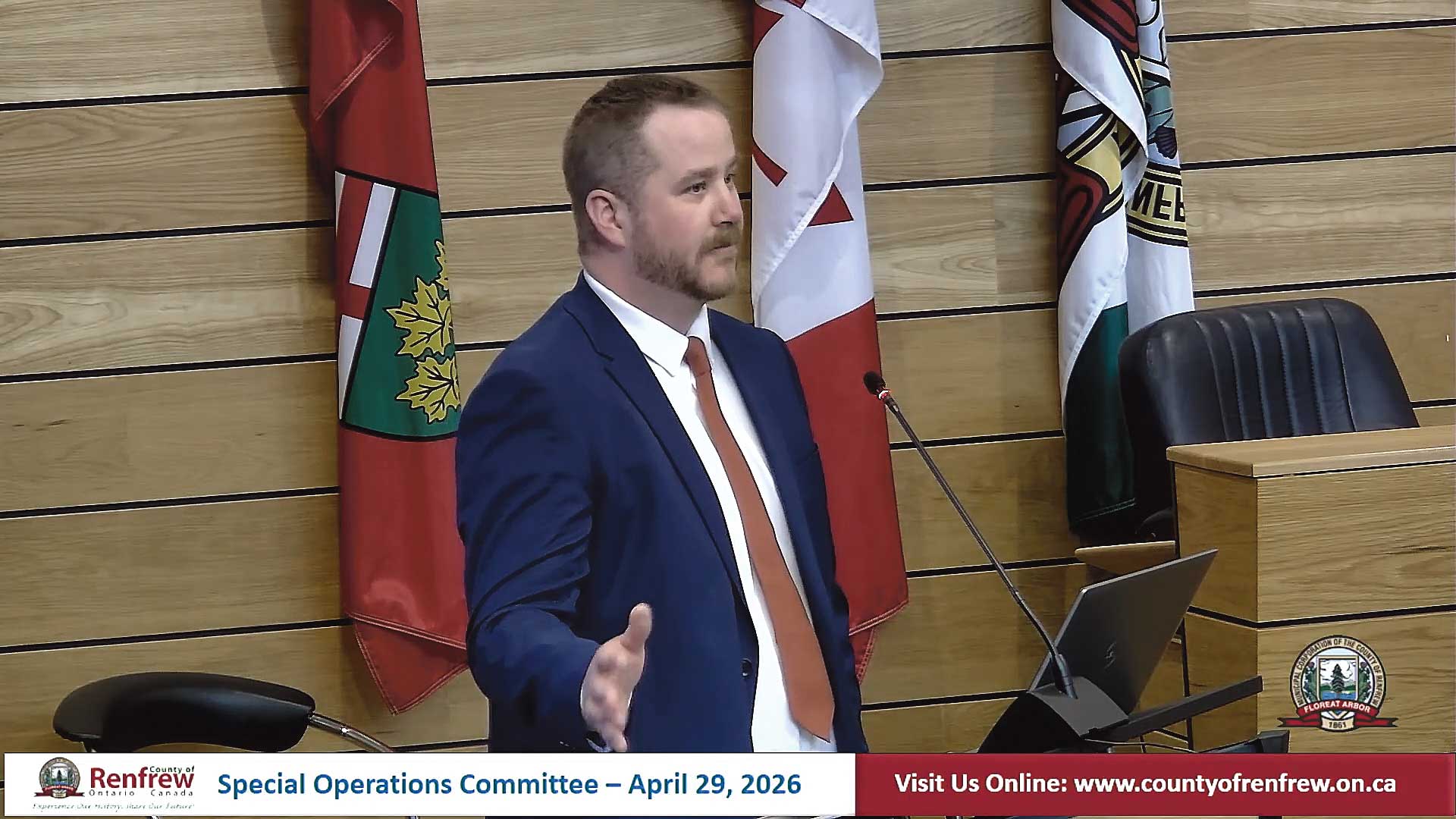
County of Renfrew Manager of Capital Works Taylor Hanrath presents an updated Transportation Master Plan at an April 29 special meeting of the Committee of the Whole, Operations.
Robert Fisher
Staff Reporter
PEMBROKE – The Renfrew County Committee of the Whole, Operations (Ops) held a special meeting April 29 to review and discuss the latest version of the county Transportation Master Plan (TMP).
In the works for several years, the plan, if finalized, would govern who is responsible for what aspects of transportation infrastructure in the county and what plans the county has for future growth and expansion.
Road rationalization – a fancy term for determining what level of government is responsible for what roads and rationale for the county to download roads (and in a few cases upload) – has been a contentious topic of conversation. County council previously produced a list of roads in several municipalities that it proposed to download to lower tier municipalities. Local councils pushed back, hard, and the county relented; at least temporarily.
The validity of the plan, in the whole, is questionable. The county previously intended to purchase and use automated speed enforcement cameras. The Province of Ontario, in November 2025, passed legislation outlawing use of the technology by municipal governments, with Premier Doug Ford referring to it as a “cash grab.”
The TMP, section 7.2.3 Automated Speed Enforcement, discusses the claimed pluses of the technology and includes a recommendation that the county, “Continue to assess the merit of implementing Automated Speed Enforcement (ASE), including reviews of safety statistics, potential sites, financial implications and Administrative Monetary Penalty System for adjudicating fines.”
The Gazette contacted Manager of Capital Works Taylor Hanrath, who presented the latest version of the TMP on Wednesday, and Chief Administrative Officer Craig Kelley to ask how the plan could be viewed as valid when it has not been updated to reflect the fact that ASE technology is outlawed in the province and has been for nearly six months.
Hanrath wrote that the TMP is a, “fluid guide for the municipality preparing policies and infrastructure planning into the future,” and that the staff completed the plan in September 2025, “prior to the province of Ontario banning Automated Speed Enforcement in November.”
The plan envisions a 20-year horizon and is broken into short (zero to five years) medium (six to 10 years) and long (11 to 10 years) funding windows. Estimated cost, in 2024 dollars based on a costing table in the document, of the short-term segment is $8.44 million. The medium-term projects total $14.395 million. The document notes the long-term projects as having a cost of $14.285 million, however, a single project in the long-term section is listed at $25.5 million.
The projects in the long-term section of the plan, excluding the one listed at $25.5 million, total $8.785 million, leaving a difference of $5.5 million for the other project if the total is supposed to be $14.285 million. If the correct cost for the lone project; cited as “Urbanization” of “Petawawa Boulevard from Victoria Street to B-Line Road” is the listed $25.5 million, the total cost for the long-term projects balloons to $34.285 million. Later in the plan, staff outline the total cost over the 20-year planning horizon at $57.12 million. That total is consistent with the Petawawa Boulevard project costing $25.5 million. The plan indicates an average contribution of $2.856 million per year over 20 years, however, does not appear to consider any rising costs over the period. A project proposed for 20 years in the future with an estimated cost of $25.5 million today would have a projected cost of $37.9 million with two per cent inflation. The average annual contribution over 20 years for that project would be $1.275 million. Assuming that contribution earned two per cent interest, the end value would be just under $30.9 million, leaving the project funding $7 million short. The annual contribution would need to earn a four per cent yearly return to fully fund the project. The plan is premised on the assumption that future councils will appropriate the necessary funding through taxation. There is guarantee future councils would do so.
A significant part of the discussion centred on the idea that there is a single taxpayer footing the bill for infrastructure. The difference is that when a road is managed by the county, all 17 municipalities contribute. When a road is managed by a municipality only taxpayers in that municipality pay for it, placing an inequitable burden on the municipality if the county decides to download one or more roads or other infrastructure.
Hanrath also presented 31 “growth projects,” all of which are in the eastern end of the county.
Hanrath proposed to take the committee through 19 recommendations and have members provide feedback on whether the recommendation is accepted, rejected or sent back for further review.
Road rationalization
Coun. James Brose opened discussion on the road rationalization issue. Hanrath presented a scoring matrix; which the committee has seen previously, to determine whether a road will remain under county control or be downloaded to a municipality. The matrix could also determine that a local road could be uploaded to the county.
Brose agreed that having a firm set of criteria to make that decision is better than a subjective assessment, “so that there’s the appearance of fairness.”
The proposed policy on road rationalization suggests 27 sections of road comprising 50 kilometres that should be downloaded to municipalities based on the scoring criteria with five sections encompassing 14 kilometres that should be uploaded to the county. All of the road sections highlighted for possible download are in the eastern part of the county with nearly 14 kilometres in Petawawa, and nearly 12 kilometres in Whitewater Region comprising the largest components of the potential transfers. The previous road rationalization proposal would have seen roads in several other municipalities, including Killaloe, Hagarty and Richards, and Madawaska Valley downloaded to local governments.
Coun. Rob Weir suggested that a simple count of vehicle types is inadequate, saying that large, two-trailer logging trucks, for example, which are extremely heavy will do more damage than a single box trailer truck in the same classification.
Coun. Neil Nicholson began speaking about overall affordability and that downloading roads to a lower tier municipality is difficult because of the increased cost. He further suggested that, while lower tier governments may not want to take on responsibility for new roads, they may have to eat the cost because the county can’t justify maintaining it any longer.
Nicholson suggested that if the county is not going to download ones it needs to do more evaluation of roads and the condition state of certain roads. He referenced that some roads may need to be evaluated differently on a criteria called Pavement Condition Index (PCI). PCI is an assessment of the condition of a road surface on a scale from zero to 100. A score higher than 85 is good, scores from 25 and under are very poor to failed. Nicholson suggested that a road which is scored 80 by the county may need to be scored as 40 locally, “because that’s what it would have in Whitewater,” and that the county would not put money into that road, moving to other “more important” roads instead. The councillor may have reversed the scale. A road would likely not have a lower score at the municipal level than it has at the county level. Hanrath confirmed that, under Nicholson’s suggestion, the example road would receive a lower design classification and that the policy allows for reclassification of a road that does not meet the criteria to be maintained by the county, however, the county keeps responsibility for it anyway.
Warden Jennifer Murphy said that downloading a road simply moves the problem from one party to another and, “doesn’t do anybody any good, in my opinion.” She began to speak about the plan as similar to the county asset management plan, in that it’s merely a broad plan and not to be followed to the letter. She stopped part way through her statement and said she would reserve her comments, “because I’m not sure how (the TMP) helps us.”
Discussion of the road rationalization policy took nearly an hour of the roughly three and a half hour meeting. At the end of the meeting, councillors voted to send the policy back to staff for revisions. Council also voted to send a related policy defining road classification back to staff for revisions.
robert@thevalleygazette.ca
About the Author