
Robert Fisher
Staff Reporter
BARRY’S BAY – The Province of Ontario has ended whatever support it may have considered giving to a bill to declare intimate partner violence (IPV) as epidemic in the province.
The coroner’s inquest into the murders of Nathalie Warmerdam, Anastasia Kuzuk and Carol Culleton made declaring IPV as epidemic the first of its more than 80 recommendations.
The NDP moved a private member’s bill in 2024 to make the declaration. The government, having previously rejected the call for declaring an epidemic, signalled its willingness to support the one-sentence bill and sent it to committee for research. The bill died on the order table when Premier Doug Ford called an early election. The NDP re-introduced the bill when the legislature resumed sitting after the election. The bill passed first reading in June and was ordered for second reading. Late last week, the NDP members of the Standing Committee on Justice Policy, the committee studying the bill, walked out and refused to continue working with the committee. The NDP members issued a statement to CBC News which read, in part, “Choosing to ensure that the process has integrity, accountability and respect for survivors now requires that we withdraw from the government’s report-writing process.” The members intend to write their own dissent to the official
committee report.
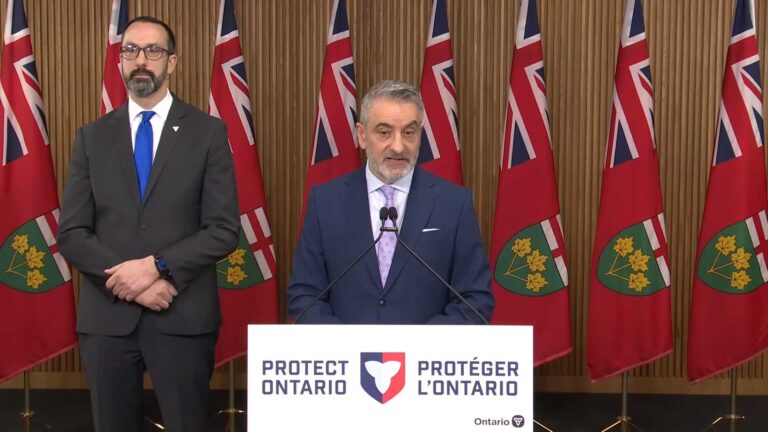
Speaking to Global News Williams said declaring IPV as epidemic would be “disingenuous” because an epidemic is short-term and, “just pops up requiring short-term solutions to address it, because you can’t make intimate partner violence go away.”
Williams’ office declined a request for the associate minister to speak. Her director of communications emailed a prepared statement which did not address the questions the Gazette has. The statement read, in part, “Ontario funds a broad range of supports for survivors such as crisis support and intervention, emergency shelters, counselling, 24-hour crisis lines, supports for survivors, their families and perpetrators of gender-based violence.” The statement cited $1.4 billion in spending over four years, “to end gender-based violence.”
MPP Kristyn Wong-Tam, primary sponsor of both bills, did not respond to multiple requests to speak for this story.
Local reaction
“To say that IPV isn’t an epidemic or to say that it would be disingenuous is kind of, to me, feels like backwards thinking,” said Lori Norwood, director of the Sexual Assault Centre of Renfrew County.
For Norwood, working in the sector, she sees the need for heightened awareness and action. The urgency and, “need for it to be escalated and called a crisis. It’s just disheartening to think that it’s a long-term problem and that it may not be solvable,” as Williams said.
Norwood said declaring it as epidemic mobilizes resources including public health involvement, funding for support and research, and education.
“The numbers are climbing steadily every year. It’s not just something that’s business as usual,” said Norwood.
The director highlighted that government support, in the form of the declaration of IPV as epidemic, provides a push from government to, not only support victims today and try to educate perpetrators; it also gives support for initiatives to initiate upstream education and awareness to prevent younger generations from becoming perpetrators, “to provide funding to help frontline workers break this generational curse that seems to be woven
throughout society.”
Teaching younger people what healthy relationships look like, providing them with good habits, good communication skills, good conflict resolution skills, “you’d be helping prevent future IPV incidents.
“But to say that it’s just an endemic, which it is, because it’s something that’s so deeply woven into our society; but that doesn’t mean that it’s helpless.”
Norwood acknowledged that eliminating IPV and gender-based violence entirely may be an unrealistic goal. Unfortunately, “it’s always going to be something that somebody has the ideology that it’s OK. But if we don’t try to change those ideas, we’re going to end up in a stalemate.
“We won’t be making any further actions towards reducing the numbers. We will just continue along a baseline that it’s OK,” continuing to say it seems the government is accepting that baseline state.
Norwood was “saddened” when she read Williams’ remarks because, “with an attitude like that, then we’re never going to be able to work towards change.” As a society, we shouldn’t give in to the baseline and we shouldn’t give up on trying to effect change. “It’s not just because it’s difficult and just because it’s been that way for so long, doesn’t mean that it’s okay. It doesn’t mean that it’s right and doesn’t mean that it doesn’t need to change.”
She said, in her discussions with other advocates and support providers she has seen no indication that the government considers IPV a priority. She acknowledged that the government has added some funding to address GBV. “There’s just so much more that could be done. The comment (from the associate minister) just seems like she’s giving up.”
The government position highlights the importance of events like the vigil at the Women’s Monument in Petawawa on Dec. 6. “We need to continue to talk about those that are being affected by it and we need to continue to work towards change.”
A broader perspective
Harmy Mendoza is executive director of WomanAct, a non-profit that advocates for women and gender-diverse people to have economic security and live free of violence. She framed Williams’ remarks in the context of November being Women Abuse Prevention Month and the period from Nov. 25 to Dec. 10 as 16 Days of Activism Against Gender-Based Violence.
Williams’ remarks, to Mendoza, say, “there is not urgency. It says to me that there is no real actions that are meant to accompany any declaration.”
She welcomes the government declaring IPV as endemic which recognizes there is an issue. She agrees with the government that it is a long-standing problem, however, feels more is needed. Approximately 100 Ontario municipalities, including the County of Renfrew, have made the declaration. They have done it because, “we want to stress the urgency and the magnitude of the issue.
“That is the concern I have, in terms of her response, it’s that there is a complete dismissal to the urgency and magnitude of this issue,” said Mendoza. She wants to see words matched with action to stem the reports of IPV incidents and femicides.
Resources need to be put into education and awareness for prevention and it needs to be a collaborative effort between government and community. Actions and plans need to be evidence-based and recommendations need to be implemented.
The Ontario Domestic Violence Death Review Committee makes recommendations to government on prevention, intervention, structural matters such as housing and economic security. They also have started reporting on issues of digital abuse.
The provincial government is, “in charge of ensuring services and structures related to domestic violence and intimate partner violence exist and are properly supported.” She highlighted that declaring IPV as epidemic stresses the urgency of the problem. “It’s very disappointing to hear that’s not where our provincial government is,” especially coming into the 16 days of activism.
“Your community, in particular,” she said, referring to Renfrew County, “when it comes to femicides,” and in the inquest recommendations. “We know this is the first recommendation.”
Mendoza noted the swiftness governments used to deal with the COVD-19 pandemic and said government should move with equal swiftness on IPV.
She ended on a positive note, saying, “I have seen good things happening, especially when communities come together and demand action, demand a response.
“I recognize that the acknowledgement, at least as an endemic is a step.” It is, “not responding to the call for urgency and to stress the magnitude of the issue.”
robert@thevalleygazette.ca
About the Author