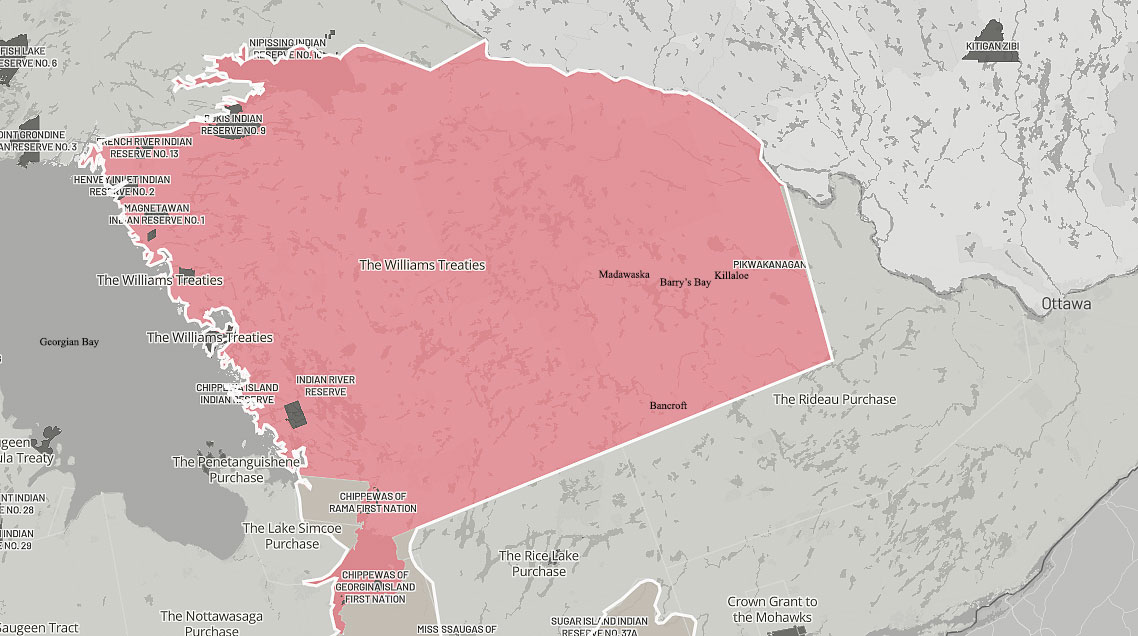
Source: Yellowhead Institute. The red area shows the area covered under The Williams Treaties.
Editor’s note: Tina Steele (Zhaab Waabi Kwe , She Sees Through Clearly Woman) was called away on a last-minute emergency. The Gazette editorial policy generally doesn’t permit completing full interviews via email. Steele kindly took the time to send an email outlining the importance of Indigenous History Month. We are setting aside our editorial policy in this instance and are presenting her remarks unedited, except for corrections to typographical errors and explanatory notes.
WILLIAMS TREATY TERRITORY – Tina Steele (Zhaab Waabi Kwe, She Sees Through Clearly Woman) is a spiritual knowledge keeper and advisor, and member of the Hiawatha First Nation.
Why is First Nations Month (Indigenous History Month) important? To help shed light on the discrimination and atrocities that were done to First Nations families and children. That was swept under the carpet, twisted and hidden from members of the new colony “ Kanada”. (Editor’s note: Kanada, with a k, is a derivation of the Huron-Iroquois word kanata, which means village or settlement. The word was eventually changed to Kanada as a phonetic pronunciation and later changed, possibly by French settlers, to Canada)
To help shed light, break cycles and stigmas about the Nations’ past, present and future.
That Kanada, was built on the genocide of thousands of First Nations children for land occupation of many settlers.
We were once a thriving people that believed and acted on sovereignty, health and unity.
To help create an understanding and awareness. To invite in meaningful, respectful and loving conversation to create a more equitable society.
How many are in the process of recovering history? The past 30 years, First Nations have risen significantly in getting back their language, teachings and culture through oral passed down knowledge and petroglyphs.
Even just 40 years ago, our ceremonies, human presence and language was not allowed within the system. Many families practiced language and ceremony in secret to keep it alive and passed down.
More and more families are taking their skills back through foraging, harvesting and growing their own medicines and foods again.
Importance of passing down knowledge. Every community (federally recognized Reserve) has their own Knowledge Keepers , Advisors and Leaders.
Like the past, anyone in the community whether on or off reserve, born with natural abilities, passed down knowledge or education from the system is sometimes recognized with a role in the community to continue passing down skills, sovereignty and knowledge. Whether that’s wild rice harvesting, canoe or wigwam building.
There are also some spiritual knowledge keepers that teach and advise in healing and spiritual work.
There are also Midewiwen Societies. That is a group with initiation for ceremony, reconnection and teachings.
There are also many knowledge keepers that live off reserve that form their own (group). Every knowledge keeper has their purpose. Our original way, we are slowly relearning. That original way was inclusion, compassion, courage, wisdom and humility.
How history and culture were harmed during colonization. During the years of residential schools, many records were destroyed of children that were taken. The new government even formed the RCMP to specifically take the children by force and jail or kill anyone that got in the way of it. Parents would try to see their children at these institutions to be turned away or told their child, “Died under circumstances they couldn’t prevent”
Their First Nations names, identity and language were stripped from them to be given new identities and English names.
Understanding the uncomfortable truth that the system created inequalities and injustice. And how badly that impacted the generations of First Nations people. It unfortunately created a lot of hate and stigmas about us. With some of those beliefs still acted on and alive in this modern day.
This is why we First Nations invite you in with our spiritual knowledge keepers for meaningful conversations to understand the truth. To invite in compassion, understanding and unity.
Give land acknowledgement when due. Learn about the Treaties that are still not recognized to this day, over 200 years later. Learn about the many nations that once thrived here. A stigma I would like to see ended, is the rumor we were a conflicted people at war with each other. Impoverished, starving and incapable. To this day, I sadly still hear non-natives tell us, “thank goodness they came along or we would still be savage.”
We must end this false belief to create healthier and mature friendship.
This area from Bancroft all the way up to North Bay was once acknowledged as the Williams Treaties Territory with the Michi Saagiig Anishnaabek. And that treaty territory goes all the way into Peterborough.
The Williams Treaties Territory
Editor’s note: The following dialogue is copied verbatim from the Yellowhead Institute description of the Williams Treaties
The Williams Treaties are agreements between the Crown and the Anishinaabeg.
As settlement pushed north through the 1860s, Anishinaabe leaders from Lake Simcoe and Lake Ontario demanded that federal and provincial officials address their outstanding claims to lands linked to the fraught Gunshot Treaty and John Collins Purchase. After a 1916 inquiry confirmed irregularities around lands covered by the 1850 Robinson Huron Treaty, Ontario and Canada appointed a three-man commission to investigate these earlier treaties. In 1923, the commission, led by Angus S. Williams, conducted interviews in seven Anishinaabe communities. They confirmed that many pre-Confederation treaties negotiated in the region were deeply problematic.
Yet, the commissioners were little better than the negotiators of those earlier treaties. Williams and his colleagues knew that the value of the lands far exceeded the sum authorized by Ontario. Rather than negotiate, the commissioners simply insisted on terms of a new “basket” treaty that would override and replace the originals with a massive new treaty that finally offered the Crown certainty over the land. For this to happen, a formal “surrender” was required, as well as the prohibition of Anishinaabe economic activity in the area, a reduction in the size of their existing reserves, and a one-time cash payment of $25 per person.
The Anishinaabeg rejected the commission’s proposal and subsequent agreement, but the government began prosecuting Anishinaabe hunters. Leaders such as Chief Bigwin organized campaigns against the commission, but this coincided with the Indian Act preventing First Nations from hiring a lawyer. When that prohibition was lifted, the Anishinaabeg returned to litigation and land claims, ultimately culminating in the largest specific land claim in Canadian history, settled in 2018.
While there is currently an “interim” agreement permitting Anishinaabe to hunt in the region, it is unevenly enforced with no permanent solution in sight.
We also unfortunately deal with culture fraud. It’s a huge problem many of us as spiritual leaders and community leaders are dealing with. Self-proclaimed individuals with zero lineage or a lineage that goes too far back. We unfortunately have to fight the federal government on this.
So, we try to educate the public to get to know established First Nations communities with consistent lineage. Some self-proclaimed will make up their own organization and membership cards.
Impact of Bill 5. Bill 5 was a direct violation of a long-standing treaty agreement that’s older than everyone today. (A violation) to respectfully include First Nations on decisions. To rip up the land for personal gain and use. First Nations leaders are frustrated by this because we are trying to cycle break and create unity by sharing the land and protecting any habitat of wildlife and medicinal plants.
Zhaab Waabi Kwe
She Sees Through Clearly Woman
Michi Saagiig Anishnaabe Kwe
Spirit Knowledge Keeper
My personal role is I assist in trauma healing, passing down medicine and food sovereignty skills. I also provide Spiritual Teachings in healing circles and promote communication and unity. Individuals and families come to me for coaching and direction.
I’ll also be ordained this fall to perform traditional Anishnaabe weddings and other services under an Ontario licence. I’ll be passing down the knowledge to keep these practices.
About the Author