
Robert Fisher
Staff Reporter
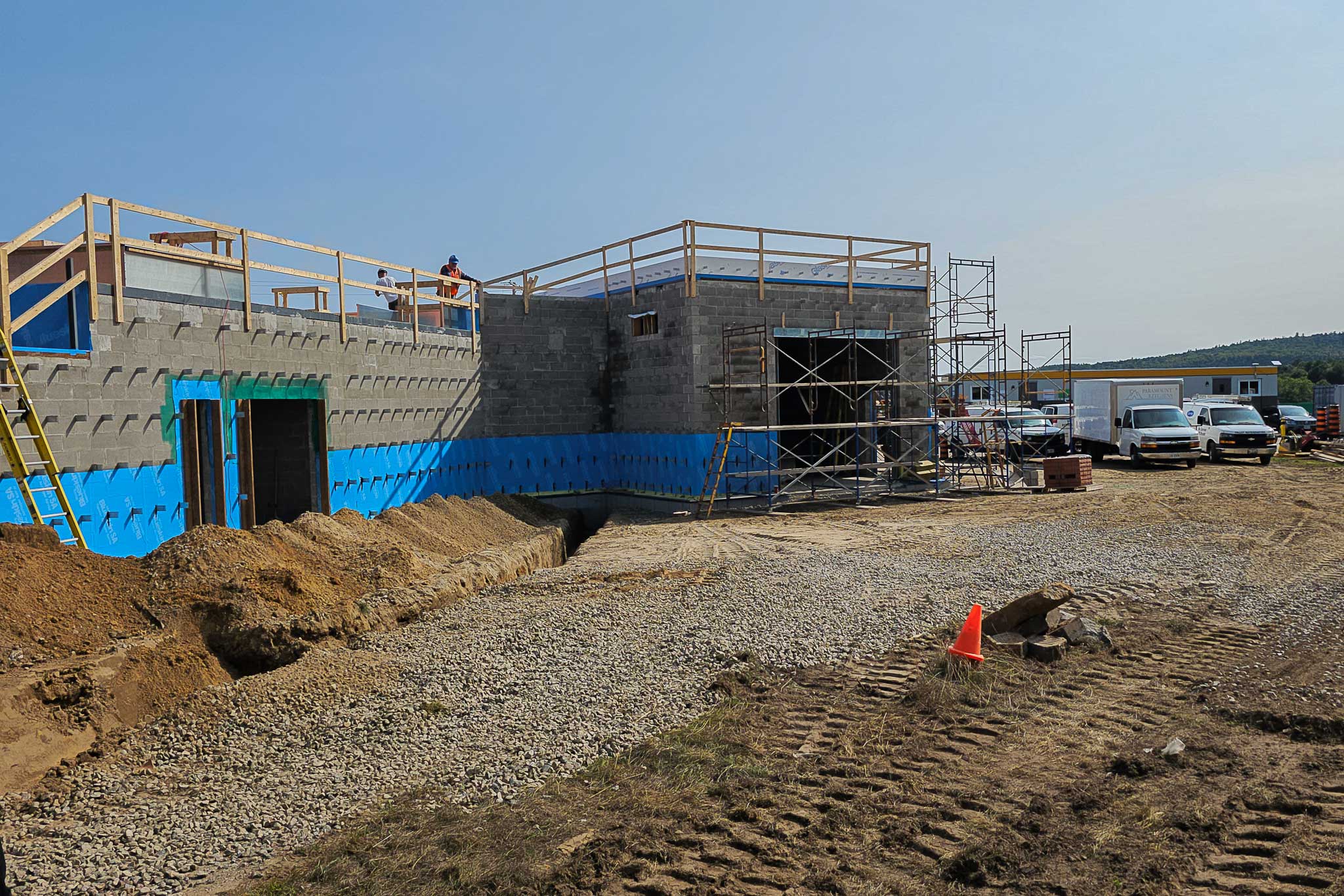
BARRY’S BAY – Renovations to improve emergency and ambulatory care at St. Francis Memorial Hospital (SFMH) in Barry’s Bay are progressing well and hospital executives are excited for what is to come for the community.
The Gazette recently sat down with newly-appointed Chief Executive Officer Suzanne Madore and Chief Financial Officer Greg McLeod to discuss the project.
The work encompasses enlarging the footprint of the hospital to build a new emergency department (ED) and renovations to the existing interior for an improved ambulatory care unit.
Ambulatory care is outpatient care that is not handled in the emergency department. “You come in, you go home,” said Madore, simply. Telemedicine is a big component of the unit at SFMH. McLeod explained that people can go to the hospital to have a telemedicine appointment with a specialist, for example. The hospital also partners with home and community care to provide services that might not be possible in a home setting. The unit also provides followup care for things such as changing dressings or removing stitches. “Rather than go to the (emergency department) they would go to our ambulatory care clinic,” McLeod explained. The new clinic will also allow the hospital to combine some other services that are currently done elsewhere in the facility, improving efficiency and patient handling.
The new ambulatory care clinic will take shape after the new emergency department is completed. The current waiting room inside the entrance and what is now the emergency department will be renovated for the new ambulatory care clinic. Hospital registration and patient records will also move into that renovated space.
“The biggest change that people will see is the (emergency department) itself,” McLeod said. The current space is not optimized for the latest government standards in health-care provision. Patient privacy and infection control will be greatly enhanced with the new department. Currently there are only two rooms in the department with doors. The rest are beds separated by a curtain. The new ED will not provide more beds than exist now, however, the patient experience and health-care worker experience will be much improved. All of the rooms will be private. The current, small nursing station will be larger to provide more room for nurses to work. There will also be space for paramedics to work and do paperwork. Right now, they try to cram into the same space as the nurses.
All of the patient rooms will be visible from the nursing station, as well. Something that is not the case currently.
The new ED will also include an isolation room for infection control. The space will have an anteroom where a health-care provider will enter, wait for a signal then enter the isolation room. The isolation room has separate ventilation from the rest of the hospital so potentially contaminated air is handled and filtered separately from general hospital air. The isolation room incorporates, “best practice from an infection control perspective,” Madore said, and the anteroom will be large enough for health-care workers to put on and take off personal protective equipment as needed.
Current regulations require that air not only be mechanically filtered but passed through an ultraviolet light, as well. Ultraviolet filtering will be incorporated into the new air handling system. There are also regulations governing the size of a patient room, which are being incorporated into the new design. The design will improve how health-care workers interact with and around a patient, making their work more efficient.
“We learned a lot through Covid,” McLeod explained, “and in the planning of this project, we had initially drawn up the (ED) and the Ministry of Health put us on pause,” to re-evaluate the plans from an infectious disease perspective. “A lot of those features are incorporated into this as well,” making the new facility better for health-care workers to provide patient care.
A mental health room is being incorporated into the new design, too. The room will be specifically for a patient experiencing a mental health crisis. The room will enhance both patient privacy and safety, and health-care worker safety.
One big change will be how ambulances enter the facility. The design incorporates a new ambulance bay/garage which will allow ambulances to enter and transfer patients in an enclosed area, out of the elements. The door on the ambulance garage will raise and lower in less than a second.
The helipad at the hospital has been moved during construction. The new helipad will be in close proximity to the ED entrance allowing patients to be moved directly from the air ambulance to or from the hospital. At some hospitals, the helipad is some distance from the facility, requiring patients to be moved by ground ambulance from or to the helipad. A nearby slope is being reinforced for the helipad.
The ED at SFMH averages 32 patients per day throughout the year. That number grows to more than 50 during the busier summer season. The department is on track to see more than 13,000 patients in 2025, a seven per cent increase over 2024. The helipad sees about 25 landings over the course of a year.
“A lot of the project sort of brings us to a standard of care where it enhances, not only the inpatient unit but the rest of the building,” noted McLeod.
The new ED will have its own waiting room and there will be a separate waiting room for ambulatory care and a separate general waiting room. Currently there is a single waiting room for everyone.
A point of pride for SFMH is that the hospital has never had to close its ED, while other hospitals are closing emergency care some nights or for several nights due to a lack of staff.
“It’s the dedication of staff and physicians to this community,” said Madore matter of factly. “Recognizing the importance, given the distance between this hospital and any other urgent or emergency services at that time of night.
“The importance of being able to keep this emergency room open is really what drives that dedication.
“We have been very fortunate,” she continued, “and I think it’s the culture that’s been built here in terms of the dedication and compassion for patients and community.”
McLeod echoed Madore’s thoughts, adding that even on long weekends, “they always step up. They always make sure. There’s always a sense of obligation that is greater, beyond a job, that calls them.”
The CFO added that he, Madore and the rest of the executive team appreciate and thank the staff for their dedication. “It’s the people who actually do it.”
The quality of care is maintained, as well, McLeod said. It’s not just about having a body in the nursing station. He also said locum or travelling doctors who come to SFMH remark about how well trained and how dedicated the local staff are. The hospital, for example, is a Best Practice Spotlight Organization with the Registered Nurses’ Association of Ontario, which is a program of ongoing training and skills development.
Patients, McLeod added, “can be assured that we maintain that (high) quality,” health care for the community, through the ongoing training and skills development, much of which is undertaken by the nursing staff on their own initiative.
Madore and McLeod also highlighted that the contractors working on the project are largely local. The general contractor M. Sullivan & Sons is based in Arnprior. Valley Refrigeration is out of Pembroke and other sub-contractors are from the local area.
The new emergency department is scheduled to open in June 2026. Interior renovations for the new ambulatory care clinic will start after the ED is open and are scheduled to finish in 2027.
robert@thevalleygazette.ca
About the Author